Business audit, revenue optimization, repositioning, and new service idea validation for a growing marketing agency
Overview:Stratosphere, a newly acquired marketing agency, brought in strategic support to evaluate the health of the business, identify revenue opportunities, and refine positioning during its transition under new ownership. The founder needed clarity on what was performing, what was limiting profitability, and how to restructure the agency for
long-term scalability.
In parallel, Stratosphere was exploring an innovative service model: for ecommerce businesses. The goal was to validate whether the idea solved real market pain and whether it represented a viable new revenue stream.
Challenge: With evolving goals and a new direction, Stratosphere needed a grounded understanding of its internal performance and a clear signal on whether the
loan-supported services model held strong market demand.
Key challenges included:
Pricing and service packages not aligned to value
Diluted positioning and unclear ICP focus
Operational gaps across sales and delivery teams
Lack of structure for scalable, higher-margin offerings
Need to validate demand for the new business idea
What was done:
1. Full Business Audit & Internal Analysis
Conducted a deep operational audit across workflows, team responsibilities, and technology
Analyzed past and current customers, churn reasons, objections, and most-used services
Reviewed the entire sales process to identify breakdowns and inefficiencies
Assessed profitability across services, customer segments, and delivery models
Mapped opportunities for cost reduction, higher margins, and improved retention
Provided actionable recommendations to restructure pricing and redesign service packages
Repositioned the agency from collision-focused services to the broader automotive sector
Identified upsell and cross-sell opportunities to increase revenue per client
Proposed operational improvements through AI and automation
Clarified team roles, responsibilities, and process ownership
Strengthened the sales process to improve qualification, closing, and onboarding
3. New Service Model Research & Validation (Financing for Marketing Services)
Conducted market and competitor research to assess the viability of marketing-service financing
Spoke directly with e-commerce founders to understand pain points around cashflow, growth constraints, and service affordability
Validated new business idea as a differentiated, high-demand opportunity
Built the initial business model, including value proposition, risk safeguards, and high-level GTM direction
Impact and next steps
The engagement provided Stratosphere with a clear strategy to improve profitability, strengthen its service model, and optimize internal operations. With refined pricing, better positioning, and clearer ICP focus, the agency is now better structured for predictable and sustainable growth.
A new service model was validated as a promising direction, giving the founder the confidence and insight required to move into detailed development, pilot planning, and capital structure design.
Strengthening positioning and messaging, rebuilding funnels, and improving conversion rates
Overview: Lichen Air is a premium, doctor-designed air purifier brand focused on brain health, longevity, and removing ultra-fine pollutants. While the product had strong scientific credibility, existing marketing assets weren’t fully communicating its differentiation — HEPA 14 filtration, third-party testing, real-time monitoring, and the founder’s medical authority.
The engagement focused on auditing all marketing and business assets, sharpening positioning, improving conversion flows, and developing campaigns that clearly articulate the product’s benefits and competitive advantages.
Challenge: As Lichen Air prepared for its next growth phase, the founder recognized that several marketing assets were underperforming and do not convert. Before scaling acquisition efforts, the company needed clarity, stronger messaging, and more conversion-ready touchpoints.
Key challenges included:
Under-optimized funnels, website and landing pages
Unclear messaging hierarchy
Lead magnets and newsletters not aligned to funnel stages
Inefficient funnel flow and missed trust-building opportunities
Limited integration of founder and expert credibility
What was done:
1. Complete Audit of Marketing & Business Assets
Reviewed website, landing pages, funnels, newsletter, and lead magnets
Assessed UX, clarity, hierarchy, and overall conversion flow
Identified messaging gaps, trust-building opportunities, and key points of friction
Delivered actionable CRO recommendations to increase clarity and conversion rates
2. Positioning & Messaging Strategy
Refined Lichen Air’s narrative around brain health, longevity, and home air quality
Highlighted doctor-led design, HEPA 14 filtration, and third-party certification as core differentiators
Created messaging pillars focused on health outcomes, product credibility, and real-world use
Built frameworks to integrate the founder’s personal brand and expert endorsements
3. Campaign Development & Activation
Crafted new campaign concepts to educate consumers about PM2.5 risks and the
benefits of HEPA 14
Developed clearer, conversion-aligned landing page structures
Strengthened the email and lead magnet strategy to support nurture and
trust-building
Ensured that all new campaigns communicated the product’s advantages simply
and effectively
Impact and next steps
The engagement provided Lichen Air with a sharper GTM foundation, clearer messaging, and more conversion-ready marketing assets. With optimized positioning and new campaigns, the company is now better equipped to educate consumers, differentiate in a crowded market, and scale sales of its science-backed air purifier.
Next steps include implementing CRO improvements, expanding educational content, and building further founder-led brand authority.
The client is a lead-generation agency that provides warm leads to service-based businesses. While they had already achieved product-market fit in their lower-tier segment, they were exploring new revenue streams — either by diversifying their services or moving upmarket to significantly multiply their revenue within the next 90 days.
Challenge: Despite strong momentum, the company faced several challenges limiting efficient expansion:
Limited visibility into true profitability across all acquisition channels
No unified performance dashboard connecting CPL, conversion rates, CAC, and revenue
Lack of a scalable acquisition strategy beyond paid ads
Inconsistent lead quality and unclear SQL criteria
Need for stronger offer structure and sales enablement assets
Desire to scale 10× without ballooning costs or increasing operational load
The company required strategic GTM leadership to strengthen its acquisition engine and prepare for sustainable scaling.
What was done:
1. Performance & Profitability Audit
Analyzed all historical performance, including CPL, conversion rates, CAC, and cost structures
Built a complete P&L model to identify profitable vs. unprofitable channels
Established benchmarks to guide the 90-day scale plan
2. GTM Strategy & Offer Structure
Created a 90-day growth strategy focused on achieving a 2× performance improvement, as a 10× target was unrealistic after validating their historical performance.
Designed a new customer acquisition strategy leveraging paid partnerships
Introduced tiered service packages to increase LTV and clarify positioning
Defined SQL criteria and aligned lead quality expectations
3. Funnel Optimization & Paid Media Oversight
Led Meta and Google campaign strategy and optimization
Built high-converting funnels and ads
Improved lead quality while maintaining cost efficiency
Achieved a major growth milestone: scaled leads from 187 to 300 in September while keeping CPL consistent with the prior 3-month average
Created all updated marketing and sales materials (sales deck, one-pager, funnel assets)
Impact and next steps
The engagement gave the company a clear understanding of its profitability, stronger acquisition systems, and a focused path to scale. With a refined GTM strategy, optimized funnels, and diversified acquisition channels, the company is now positioned for predictable, efficient growth and confident execution of its 90-day scale plan.
Market Research and Competitor Analysis for AI startup GTM 2.0
Overview:
AI Career Coach, an emerging player in AI-driven career development, faced challenges in scaling due to consistent objections during the sales process. These objections largely stemmed from comparisons to both direct competitors and widely accessible LLM platforms like ChatGPT, Claude, and Gemini.
The team struggled to clearly articulate their unique value beyond what general-purpose AI tools offer, which raised questions about how other players in the space successfully positioned similar solutions. To uncover potential repositioning opportunities, AI Career Coach decided to conduct in-depth competitor research — analyzing both direct career coaching apps and indirect LLM-based tools dominating the market.
Challenge:While AICareerCoach had a strong product vision and growing user base, it lacked a unified perspective on competitor behavior and strategy. Core challenges included:
Limited clarity on competitors’ product strategies and high-impact initiatives (“big bets”)
Fragmented insights into how competitors communicate value, acquire customers, and structure pricing
Need to understand commercialization strategies and revenue models across direct and adjacent players
Desire for a holistic, data-supported benchmark to guide future marketing, product, and business development decisions
What was done:
1. Targeted Competitor Analysis
Conducted a structured review of the competitor set, encompassing both direct rivals such as Skill Up, Careerflow.ai, FutureFit, as well as broader market leaders in AI-driven career services
Analyzed each company’s product direction, innovation priorities, and “big bets” to assess where they are investing resources for long-term advantage
Evaluated positioning statements, customer value propositions, and messaging frameworks used across digital and offline touchpoints
2. Comprehensive Strategy Audit
Assessed go-to-market approaches, including sales funnels, campaign structures, and communication channels
Reviewed pricing models, service tiers, and value justification methods — including direct outreach where required
Audited publicly available materials such as reviews, press releases, webinars, podcasts, thought leadership content, and conference participation
Identified patterns in how competitors leverage credibility, community, and content ecosystems to attract and retain customers
3. Insight Development & Recommendations
Compiled findings into a detailed strategic intelligence report highlighting competitive benchmarks, opportunities, and gaps
Delivered actionable recommendations on product differentiation, strategic messaging, and potential innovation paths
Provided a clear framework to guide AICareerCoach’s next-phase investments in positioning and Go-to-Market 2.0.
Impact and next steps
The project equipped AICareerCoach with a holistic, evidence-based understanding of its market environment. The resulting insights clarified how leading competitors position themselves, communicate impact, and drive customer growth — and, more importantly, where AICareerCoach can outperform. With this intelligence, the company is now positioned to refine its go-to-market strategy, sharpen its brand narrative, and invest confidently in initiatives that align with future market trends.
Transforming Marketing Agency Operations with Automation and AI for Scalable Growth
Overview: ScaleLite, a growing marketing agency, sought to optimize its end-to-end workflows from sales to client onboarding and actual service delivery — by integrating AI and automation into its daily operations. The goal: eliminate inefficiencies, strengthen process consistency, and prepare for scalable growth.
Challenge: Recently, ScaleLite onboarded 3x more clients than they typically service simultaneously. This rapid increase prompted the founder to rethink internal operations to sustainably support the agency’s growth.
Instead of immediately hiring additional account managers or marketing staff, the founder aimed to automate manual workflows and equip the team with AI-powered marketing tools and agents — ensuring consistent, high-quality service delivery at scale.
Key challenges included:
Inconsistent Client Experience
Lack of Documented SOPs and Scalable Systems
Manual and Repetitive Workflows
Limited Strategic Bandwidth Due to Operational Overload
What was done:
1. Full Operational Audit
Mapped the complete service flow from first sales touchpoint to service delivery
Identified process gaps, redundancies, and automation opportunities
2. AI-Integrated Workflow Design
Developed optimized workflows powered by leading AI tools
Specified how, when, and by whom each AI solution should be used
Included prompt examples and measurable expected outcomes
3. System & Tool Alignment
Unified CRM, project management, and communication tools
Designed scalable automations to enhance team efficiency and reduce manual handoffs
The engagement positioned ScaleLite for sustainable growth, with improved process visibility, reduced operational overhead, and an intelligent foundation for scaling client delivery.
Dataknox.io, a solutions provider in the IT infrastructure space, set out to engage senior IT decision-makers and grow its qualified lead pipeline. To support this effort, the team implemented a streamlined LinkedIn advertising strategy paired with thoughtfully crafted post-click experiences designed to deepen engagement and accelerate the path to conversion.
Challenge: While Dataknox.io had strong technical credibility, its outreach channels lacked precision and scalability. Key challenges included:
Difficulty accessing niche segments of IT leadership at scale
Inconsistent handoff from lead capture to content delivery
A need for compelling follow-up communications that maintained momentum after initial interest
To address these gaps, the company required an integrated strategy that could both attract and meaningfully engage decision-makers in high-value roles.
What was done:
Precision Targeting via LinkedIn and Google Ads
A tailored campaign was launched to reach high-level IT professionals, including:
CXOs, VPs, and Directors of Infrastructure and IT Operations
Members of specialized LinkedIn groups (e.g., Data Center Operations, Identity & Access Management) Lead generation ads were optimized for clarity and ease of conversion using LinkedIn’s native form functionality.
2. Strategic Content Delivery via HubSpot
To maintain engagement after lead capture, a series of branded newsletters was developed and delivered through HubSpot. This included:
Professionally written copy aligned with industry-specific challenges
Curated visual assets to reinforce brand presence and subject-matter authority
Timed distribution that aligned with the user journey following initial ad interaction
3. Seamless Conversion Flow
Users who engaged with the ad were shown a native form pre-filled with LinkedIn data
Upon submission, they were directed to a tailored content experience
Follow-up communications were deployed shortly after, providing additional value and guiding recipients toward deeper product consideration
Impact and next steps
The initiative enabled Dataknox.io to build a more reliable and qualified top-of-funnel pipeline. Engagement quality improved across multiple touchpoints, and early-stage interactions were elevated through strategic content delivery.
C-suite executives and emerging leaders sought to strengthen their LinkedIn presence and personal brand. The goal was to position themselves as thought leaders, expand their digital footprint, and build influence within their professional communities. For some, this also included creating a foundation to monetize expertise through digital products.
Services provided included shaping a clear narrative, refining positioning, and implementing a content and engagement strategy to amplify visibility, authority, and professional opportunities on LinkedIn.
Challenge: Established C-Suite Leaders
Struggled to turn offline authority into a strong LinkedIn presence
Needed greater visibility with the right audience
Wanted to create a pathway to monetize expertise through digital products
Emerging Leaders
Lack clear positioning as a personal brand
Unsure about tools to use to grow their communities and gain local influence
Content lacks sharpness and hooks to attract large audiences
Outreach efforts don’t result in anything meaningful
What was done:
Narrative & Positioning Framework
The strategy began with a narrative and positioning framework, where each leader’s career history was connected to their current mission. To ensure focus and consistency, two to three core content pillars were defined, such as SaaS Go-To-Market, Whole-Human Leadership, or Innovation Systems, and the tone of voice and brand attributes were carefully aligned to reflect both credibility and accessibility.
2. Audience Mapping & Targeting
Analyzed LinkedIn networks to identify high-value decision-maker segments
Designed engagement tactics to connect with executives, founders, and innovators
Extended networks through connection requests, targeted outreach, and event participation
3. Profile Optimization
Rewrote headlines and About sections for authority, clarity, and keyword discoverability
Updated Featured sections with high-impact assets: keynote clips, case studies, and media coverage
4. Content Strategy & Cadence
Created tailored posting schedules (2–5x per week) based on client goals
Balanced quick insights, deep reflections, case studies, and frameworks
Integrated multimedia formats (carousels, videos, visuals) and giveaways to increase reach
5. Engagement & Visibility Strategy
The engagement and visibility strategy included implementing structured commenting and collaboration approaches within relevant industry conversations. Partnerships, guest interviews, and event tie-ins were activated to expand visibility, and content was leveraged across newsletters, podcasts, and YouTube to create a cohesive multi-platform presence.
Impact and next steps
Applying this framework led to:
Notable increases in follower growth and engagement from senior executives, startup founders, and industry influencers
Stronger visibility for ongoing initiatives (book launches, thought leadership series, consulting offers)
Higher inbound pipeline of collaboration requests, speaking opportunities, and client inquiries
Kinect Air, an on-demand private aviation provider, aimed to expand its footprint in
the corporate travel segment by targeting HR and operations leaders responsible for
executive mobility and team logistics. To drive interest in a dedicated flight offer, the company launched a location-specific B2B campaign built around relevance, ease, and premium service.
Challenge: The team needed a campaign that could effectively:
Capture attention from non-traditional aviation buyers (HR and Ops roles)
Communicate the value of private group travel as a business solution, not a luxury
Drive traffic to a high-converting landing page built for lead capture
Given the specialized audience and high-consideration nature of the offer, the campaign had to balance performance with credibility and localized messaging.
What was done:
Targeted LinkedIn Carousel Campaign
Launched a multi-image carousel campaign on LinkedIn with ad variations tailored to revenue tiers, roles, geography Each ad emphasized “stress-free group travel for executive teams,” positioning Kinect Air as a trusted partner for reliable corporate mobility.
2. Optimized Offer Landing Page
All ads directed traffic to a dedicated landing page showcasing the corporate flight offering. The page was designed to:
Reinforce core value propositions
Make the lead submission process intuitive and frictionless
Align visual storytelling with executive-level expectations
3. Post-Click Follow-Up Flow
Visitors who completed the form were automatically enrolled in a follow-up sequence
Follow-up content was delivered via email automation platforms (HubSpot/ActiveCampaign), highlighting service benefits and next-step options
Impact and next steps
The campaign generated qualified interest from corporate HR and operations leaders in high-priority regional markets. By refining both the message and audience, Kinect Air successfully repositioned private charter as a business efficiency solution rather than a luxury expense. Based on campaign outcomes, next steps include:
Expanding into new geographic clusters with high executive travel volume
Building out multi-channel nurture sequences to guide leads toward booking
This engagement demonstrated how targeted messaging and well-executed creative can translate even niche, high-ticket services into scalable B2B acquisition plays.
Revelate.co, a fast-growing Data Collaboration SaaS company, aimed to scale its pipeline by generating qualified leads from senior data and IT professionals. To support its growth goals, the company needed a structured paid media approach that could reach enterprise decision-makers and convert interest into meaningful leads through high-value content.
Challenge: Despite having a strong value proposition, Revelate.co encountered several roadblocks:
Difficulty reaching senior data and IT buyers via organic and outbound alone
No existing funnel structure for LinkedIn Ads campaigns
Limited clarity on which personas and messaging combinations performed best
The internal team sought a performance-focused strategy that would drive awareness and deliver measurable lead generation outcomes.
What was done:
Funnel-Based LinkedIn Ads Strategy
Deployed a three-stage full-funnel campaign:
Awareness: Sponsored posts driving blog traffic
Consideration: Retargeting ads focused on product engagement
Conversion: Lead Gen/Conversion Ads offering free assets download
2. Persona-Based Segmentation
Created custom LinkedIn audiences targeting:
CXOs (CTO, CIO, CDO)
Data & Analytics Leaders (VPs, Heads of Data)
IT & Engineering Leaders (Directors, VPs)
3. Streamlined Lead Capture Flow
Used native LinkedIn lead gen forms with autofill
Redirected submissions to gated whitepaper download
Tracked all traffic and conversions via UTM tagging
4. Tested different audiences, creatives and messaging
Impact and next steps
The campaign delivered a steady stream of qualified leads from high-value target personas. Improvements in targeting and funnel structure led to lower CPL and higher lead quality.
Crushteam.ai is an all-in-one AI-powered CRM that helps businesses launch in days, not months. It combines every key aspect of GTM in a single platform, all enhanced with advanced AI.
We worked together on the GTM, positioning, and messaging strategy, development of their startup venture lab, amplification of the founder’s personal brand.
Challenge: Key challenges included:
Position us not just as a tool, but as a true go-to-market partner
Translating the founder’s big vision into clear, simple messaging that any customer can understand.
What was done:
1. Developed the positioning and messaging strategy to present the SaaS not just as a tool, but as a true go-to-market partner. To strengthen this partner narrative, I introduced the concept of a Startup Venture Lab—designed to help startups go to market faster by leveraging both the platform’s advanced AI capabilities and the founder’s experience building 14 companies.
2. Developed a comprehensive creative and copy brief that outlined website content structure, core messaging, and brand voice—ensuring alignment with the company’s positioning and go-to-market strategy.
3. Amplified the founder’s personal brand to strengthen trust and social proof by showcasing past publications, interviews, previously built companies, and decades of experience. Also built a strong LinkedIn profile to highlight credibility and authority.
Impact and next steps
CrushTeamAI is redesigning its website to align with the new positioning and messaging strategy. The updated messaging will also be applied to sales talking points and collateral.
Wise Agents is developing custom AI agents to automate complex business processes across industries. With proof of concept already developed for three AI agents, the team faced challenges in defining their ideal customer, refining their go-to-market strategy, and deciding whether to scale as a SaaS product or a custom development service. The website no longer reflected the company’s direction, and their online visibility was minimal.
Roomz Marketing was brought in to lead positioning and messaging strategy, shape the go-to-market approach, and lay the groundwork for scalable growth.
Challenge: Wise Agents needed to address several high-stakes strategic questions:
Whether to pursue a SaaS model or continue offering custom-built agent services
How to prioritize between scaling their most in-demand agent or developing a broader agent library
Whether to focus on verticals they had domain expertise in or expand to a wider market
How to identify the most effective sales and marketing channels for early traction
How to build a customer success function that could loop feedback into positioning and product development
These decisions were essential to move forward with a focused and executable go-to-market strategy.
What was done:
Market and Competitor Research
Conducted a full landscape analysis of Agentic AI players and B2B automation tools
Benchmarked features, pricing, positioning, and messaging tactics
Identified market gaps and opportunities for differentiation
2. Internal Audit of Product and Operations
Audited the product’s current capabilities and scalability. Evaluated internal workflows, team structure, and decision-making processes to ensure alignment with growth goals.
3. Positioning and Messaging Strategy
Developed a clear and differentiated positioning centered on Wise Agents’ ability to deliver fully integrated, custom AI agents — fast. Built messaging frameworks tailored to different use cases and buyer personas.
4. Go-to-Market Strategy
Designed a comprehensive go-to-market plan that included:
Market and competitor research
Positioning, Messaging strategies
Ideal Customer Profile (ICP) definition
Sales and marketing and customer success strategies
Detailed budget, revenue models, growth scenarios, and timeline
Hiring roadmap and organizational structure
KPI tracking and reporting frameworks
5. Website Rebuild and Rebrand
Led a complete redesign of the company website to reflect the updated brand identity, value proposition, and product direction. Improved structure, copy, and design to enhance UX and conversion.
6. Investor Materials Preparation
Created an investor-ready pitch deck highlighting problem, solution, traction, and business model
Developed a one-pager for follow-ups and warm introductions
Aligned narrative and visuals with the expectations of early-stage and Series A investors
7. Sales Enablement Assets
Developed a structured sales deck and one-pagers tailored to different verticals and buyer roles. Equipped the sales team with clear, value driven narratives for outbound outreach and discovery calls.
8. Lead Generation & Outreach Programs
Designed and launched structured outreach campaigns, including:
Warm Network Activation Program to reconnect with the founding team’s contacts
Partnership Program targeting agencies and consultancies as AI integration partners
Cold Outreach Frameworks featuring multi-step cadences and value-first messaging
Impact and next steps
Through comprehensive market research, clear positioning, and a detailed go-to-market strategy, Wise Agents successfully launched a refreshed brand and website aligned with their core value proposition. Investor materials generated promising interest, supporting their bridge to Series A fundraising efforts. Early outreach and sales enablement initiatives resulted in initial customer acquisitions and meaningful pipeline development. With these foundations established, Wise Agents is now focused on refining product-market fit, expanding demand generation, and scaling growth toward their next phase.
Pre-Launch Evaluation of Fortune-100 New AI Product
A Fortune 100 SaaS company had developed a proprietary large language model (LLM) intended to power upcoming features in its enterprise suite. Before public rollout, the company needed to validate its model’s competitiveness and identify strengths and gaps relative to leading LLM providers.
Challenge: The company needed clarity on three key areas:
How their LLM performed against leading alternatives in real-world enterprise use cases
What product narratives would resonate most with potential customers
Whether the current feature set and UX could compete in the rapidly evolving AI tools market
Due to internal blind spots and the complexity of benchmarking AI performance, the leadership team sought an external perspective to surface insights, prioritize areas for refinement, and inform both product and marketing decisions.
What was done:
Competitive Benchmarking Framework
Developed a structured evaluation framework comparing the company’s LLM to three top-tier alternatives. Benchmarked performance across several use cases including summarization, ideation, document generation, and reasoning.
2. Blind User Testing and Prompting Scenarios
Conducted blind prompt testing to ensure unbiased evaluation
Simulated real-world enterprise prompts across different departments (e.g., Marketing, Legal, Support)
Scored outputs using a consistent rubric for:
○ Accuracy ○ Depth of reasoning ○ Relevance ○ Readability
3. Strengths & Gaps Analysis
Produced a detailed matrix of feature strengths, emerging gaps, and positioning opportunities. Assessed model strengths across creativity, precision, safety, and UX.
4. Narrative and Positioning Recommendations
Defined high-leverage differentiators for GTM and sales messaging
Suggested positioning angles based on:
○ Enterprise-readiness ○ Security & compliance confidence ○ Ease of integration and adoption
Proposed messaging pillars grounded in comparative data
5. Strategic Readiness Assessment
Created a final product-readiness scorecard that helped leadership understand the model’s competitive standing and readiness for launch. Included recommendations for refinement and phased rollout strategies.
Impact and next steps
The engagement helped the Fortune 100 SaaS company clarify how its LLM stacked up against industry leaders. Key insights informed the refinement of product messaging, customer onboarding design, and internal alignment across product, marketing, and sales teams.
The internal team used the findings to prioritize product updates before launch and align their GTM narrative with real-world performance advantages. This project laid the foundation for a more confident market entry, supported by positioning grounded in evidence and relevance.
Go-to-Market Strategy for a New SaaS: AI Voice Agents
This AI-driven voice agent company is transforming customer experience with intelligent, adaptable virtual agents. As they moved from MVP to a full-scale public launch, they needed a strategic partner to shape their go-to-market (GTM) approach, refine product development, and build a robust sales and marketing foundation. The goal was clear: validate product-market fit on a bigger audience and scale operations efficiently.
Challenge: With the rapid advancement of AI technologies, the market is flooded with hundreds of AI voice solutions. While some come from startups, others are backed by well-known tech companies. Our biggest challenge was identifying a niche market—specific verticals and businesses that would benefit most from our solution—while also developing strong USPs to clearly differentiate ourselves and win over customers.
What was done:
Product Development Support
Contributed to product research and development, leveraging prior experience managing 50+ member call center and customer experience teams.
Collaborated closely with the tech team to align product features with real-world operational needs.
2. GTM Strategy 1.0 (MVP Launch)
Developed the initial go-to-market strategy tailored for the MVP stage.
Crafted a flexible approach designed to evolve based on early user feedback and market response.
3. Website Launch
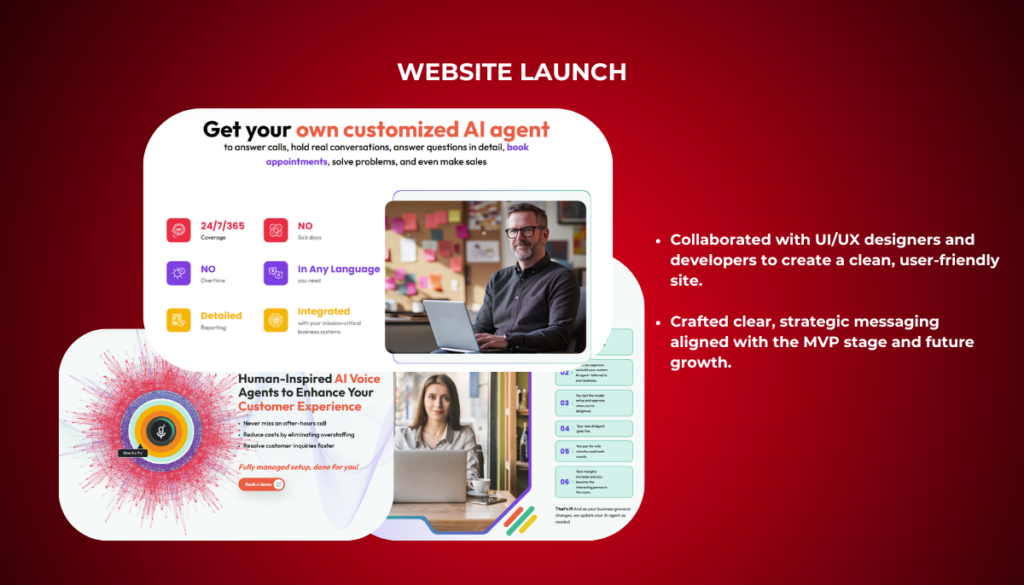
Collaborated with a UI/UX designer and developer to launch a brand-new website.
Created messaging for the MVP stage, keeping it broad and adaptable until consumer insights were gathered.
4. Vertical-Specific Landing Pages
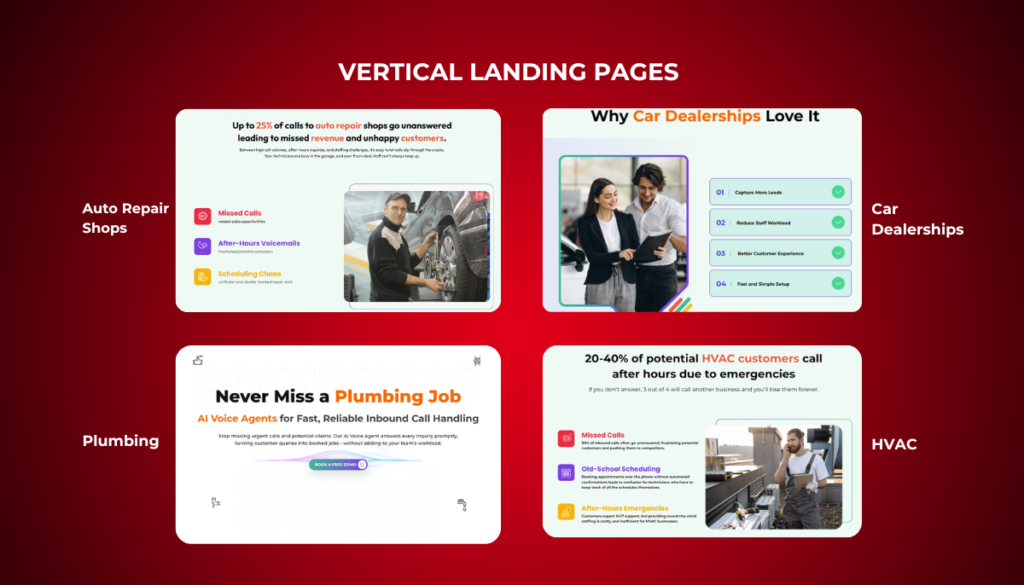
Designed tailored landing pages for different verticals to address industry-specific needs and pain points.
Conducted mystery shopping to uncover operational insights and refine sales messaging.
5. Cold Outreach Campaigns
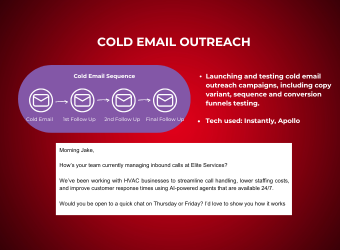
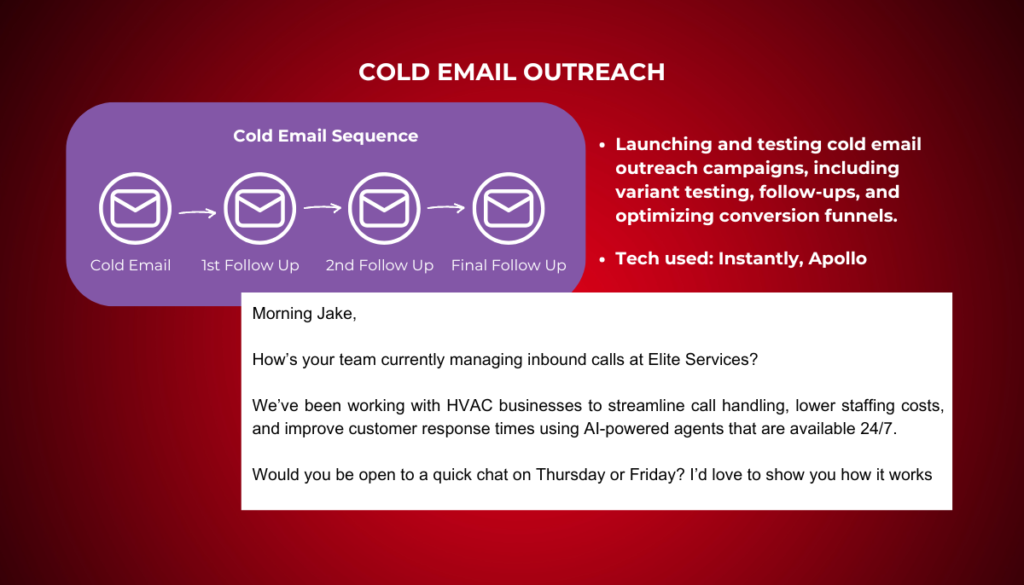
Developed and launched cold email outreach campaigns, testing different messaging and conversion funnels.
Analyzed performance metrics to identify the most effective approaches.
Launched called calling, developed messaging and call scripts, trained SDRs and stayed on top of the results
6. Sales Enablement Materials
Created a comprehensive suite of sales tools, including one-pagers, sales decks, and cold-calling scripts.
7. Sales Enablement Materials
Oversaw the development and execution of a long-term SEO and content plan to drive organic growth.
8. GTM Strategy 2.0 (Public Launch)
After validating product-market fit, crafted an evolved GTM strategy for the public launch phase.
Prepared the company for scale by aligning marketing, sales, and product efforts.
Impact and next steps
Through strategic development and execution, the company successfully transitioned from MVP to public launch readiness. The refined product, validated by market feedback, is poised for scale with a robust GTM strategy and strong sales foundation. As they move forward, ongoing SEO efforts and targeted outreach will continue to drive growth and market penetration.
WiseHosting is a dynamic Minecraft server hosting service known for offering cross-version servers, allowing seamless transitions between Java and Bedrock editions. With a goal to stand out in a highly competitive market dominated by established players, WiseHosting needed a robust growth strategy focused on performance optimization and customer acquisition.
Challenge: The Minecraft server hosting market is saturated with well-funded competitors, making it difficult for smaller providers to capture market share. WiseHosting needed to enhance its website’s user experience, cross-sell and up-sell more effectively, and leverage unique selling points like unlimited player capacity and cross-version support.
What was done:
Competitor Analysis
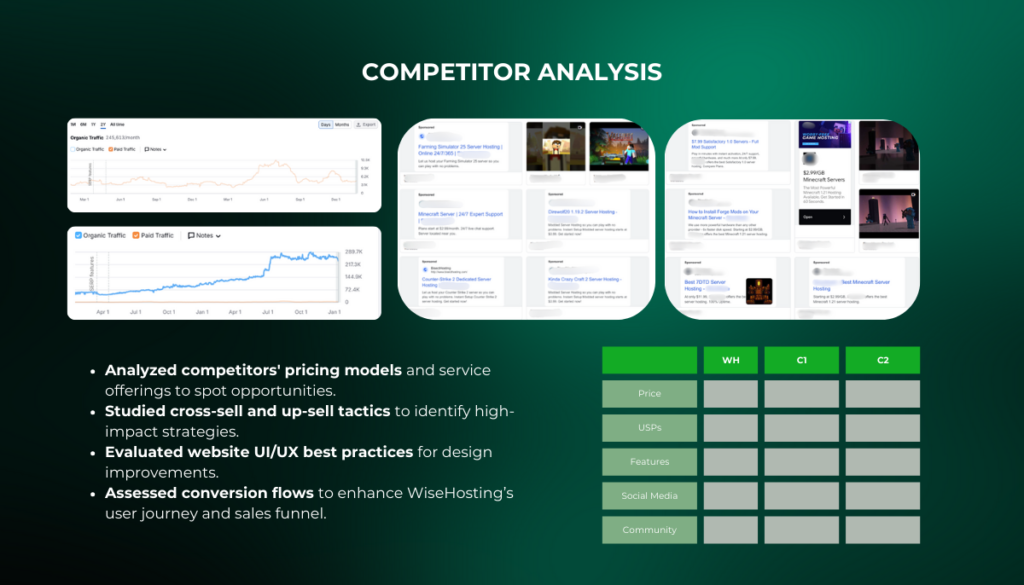
Conducted in-depth research on major competitors’ pricing models, service offerings, and conversion flows.
Analyzed cross-sell and up-sell tactics used by competitors to identify opportunities for WiseHosting.
Studied website UI/UX best practices to inform design and functionality improvements.
2. Business Audit
Evaluated WiseHosting’s current performance through data analysis and customer feedback.
Reviewed customer database to understand user behavior and identify retention opportunities.
Assessed website UI/UX for usability, clarity, and conversion optimization.
Audited content strategy and pricing packages to align with market expectations and user needs.
3. Paid Ads Strategy
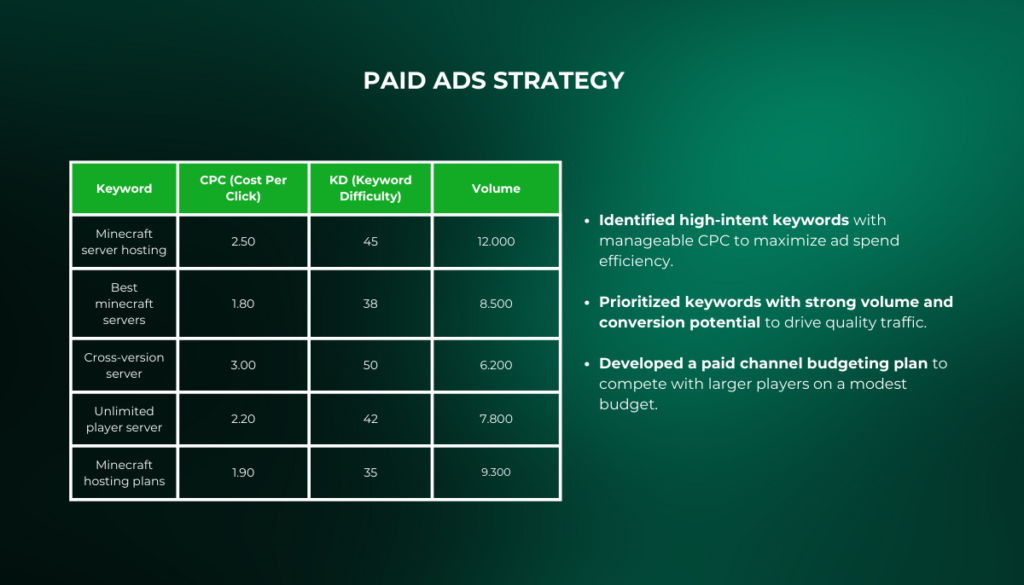
Performed keyword research to identify high-opportunity paid search terms with manageable CPC.
Developed marketing angles to compete with larger competitors on a modest ad budget.
Created a paid channel budgeting plan, prioritizing keywords with high intent and conversion potential.
4. SEO Strategy
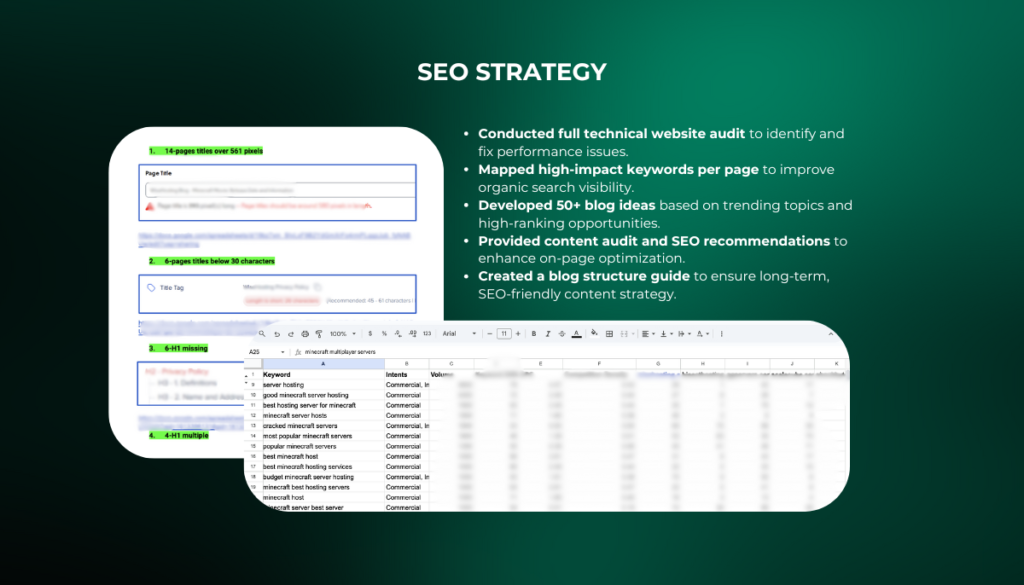
Collaborated with an SEO specialist to conduct a full technical audit of WiseHosting’s website.
Mapped out high-impact keywords for each website page to drive organic traffic.
Provided a pipeline of 50 blog post ideas based on trending and high-ranking topics in the industry.
Delivered content optimization recommendations and a blog structure guide for long-term SEO success.
Impact and next steps
Through a comprehensive audit and strategic initiatives, WiseHosting is now in a position to enhance its market presence and drive customer acquisition. The combination of improved website performance, targeted paid ad campaigns, and an SEO-driven content strategy sets the stage for sustainable growth. Moving forward, WiseHosting will continue to refine its marketing approach and product offerings to solidify its competitive advantage.
SaaS Product Development and Beta Testing: AI Voice Agents
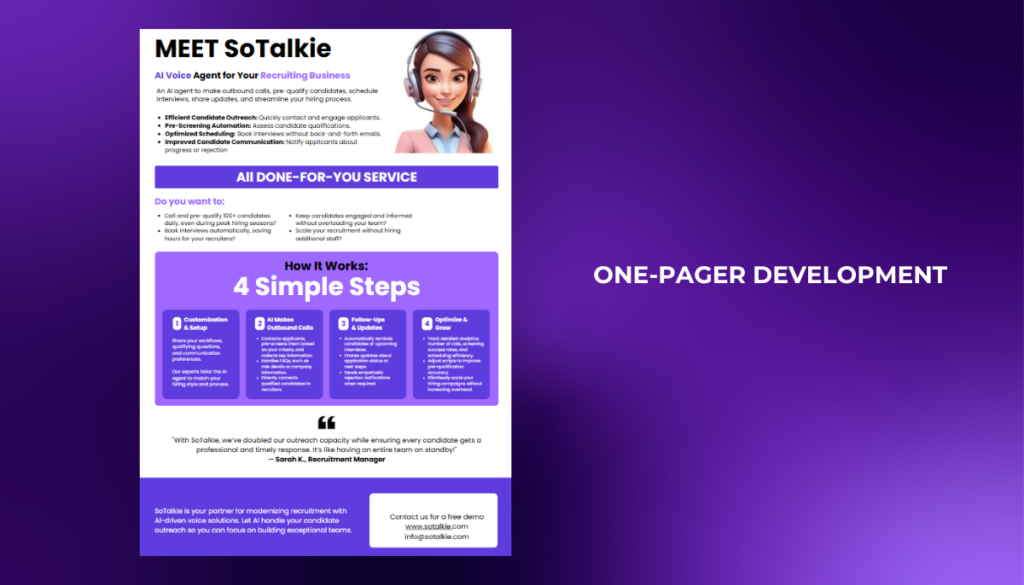
SoTalkie is an innovative AI-driven platform designed to revolutionize call support for businesses by providing intelligent, efficient, and scalable AI call agents. As they prepared to launch their product, SoTalkie needed support in finalizing their product concept, refining features, testing, and laying the foundation for customer acquisition. The primary goal was to shape a product that truly addressed market needs while building strong initial traction with early adopters.
Challenge: The AI call support industry is rapidly evolving, with increasing demand for more human-like, efficient, and adaptable virtual agents. SoTalkie needed to balance sophisticated product development with real-world usability and feedback. They also faced the challenge of validating their concept, securing early users. Entering a competitive market meant SoTalkie had to stand out through thoughtful product development, seamless user experience, and compelling communication.
What was done:
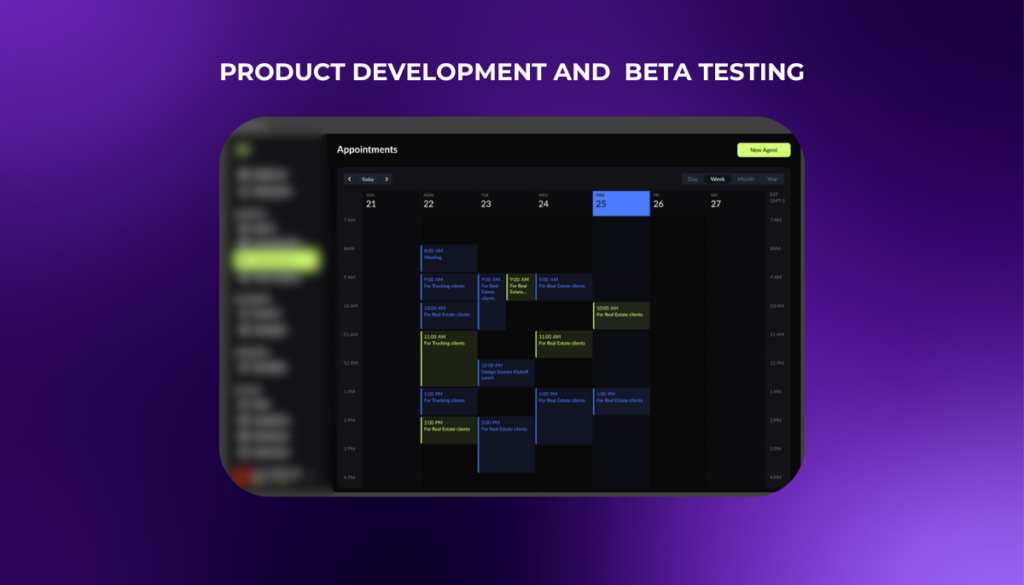
Product Development
Finalized the product concept through in-depth feature research and market analysis.
Collaborated on product development, ensuring alignment with target customer needs.
Conducted rigorous product testing to identify and resolve early-stage issues.
2. Alpha Testing
Rolled out internal testing with team members to collect hands-on feedback.
Refined product features and user experience based on collected insights.
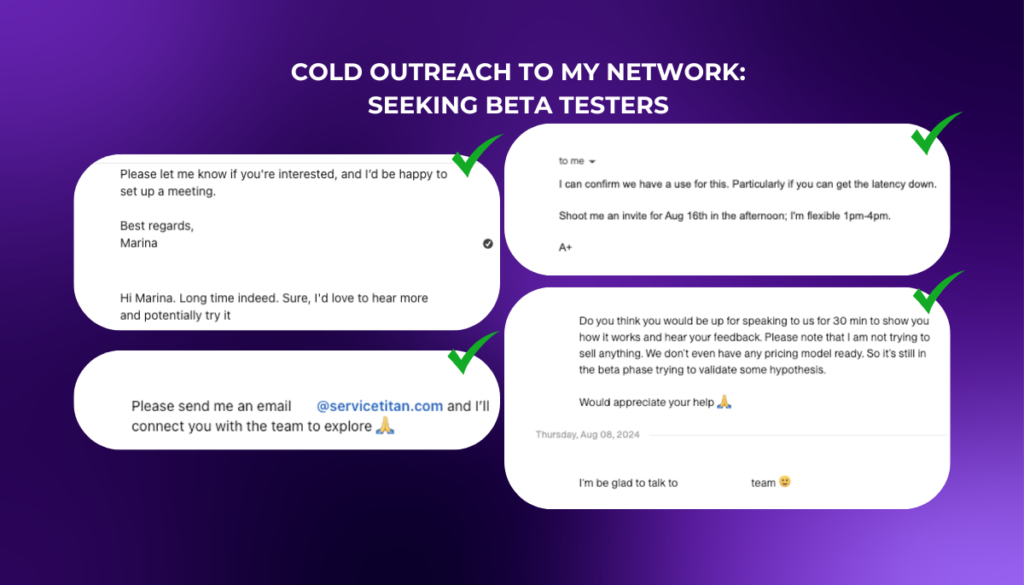
3. Beta Testing
Reached out to businesses within the network for live demos and real-world feedback.
Addressed potential customer concerns and incorporated suggestions into product iterations.
4. First 10 Subscribers
Secured SoTalkie’s first 10 paying customers through targeted outreach and tailored demos.
Personally conducted product demos and sales calls
5. Website UI/UX and SEO Consultation
Advised on website design to enhance user experience and engagement.
Provided SEO recommendations to increase visibility and attract qualified leads.
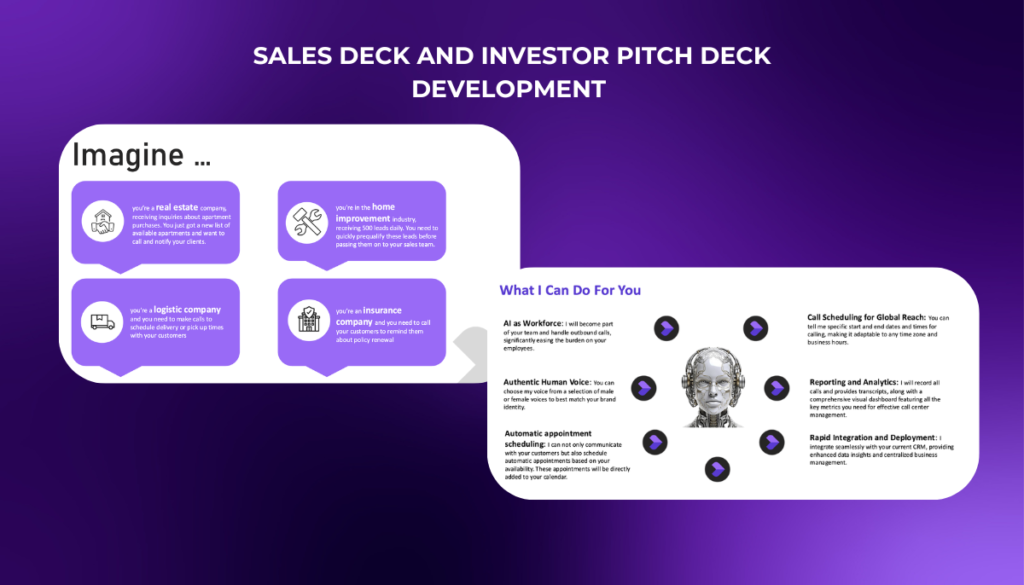
6. Sales
Created impactful sales materials, including sales decks and one-pagers, to support the sales team’s efforts.
Impact and next steps
Through strategic product development, effective testing, and sales efforts, SoTalkie launched a polished and market-ready AI call support platform. Early feedback was overwhelmingly positive, helping them acquire their first 10 customers and validate product-market fit. With a solid foundation in place, SoTalkie is now focused on scaling further and preparing for public launch.
Rebranding and Repositioning a Sign Management Company
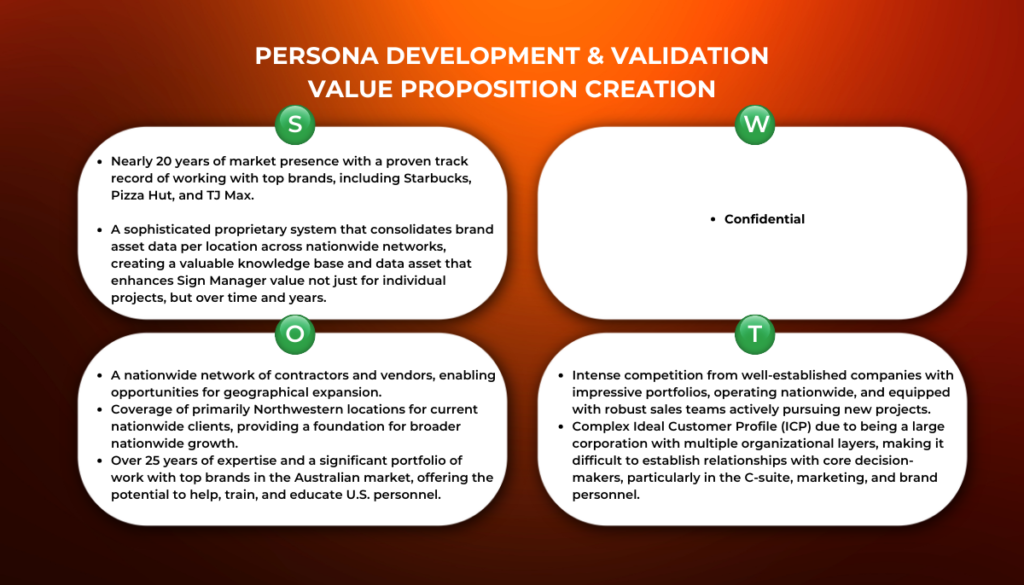
Sign Manager is a leading Australian sign management company that expanded into the US market nearly 20 years ago. Specializing in strategy and consulting, brand implementation, and brand maintenance, Sign Manager helps branded corporations manage their presence across hundreds of physical locations. With clients like Adidas, Hertz, Starbucks, Volkswagen, Europcar, and Australia Post in Australia, Sign Manager consistently delivers exceptional results that demonstrate its expertise and commitment to excellence.
Challenge: Despite being in the U.S. market for 20 years, Sign Manager’s market presence remains limited, with only one service actively sold from its extensive portfolio. As a result, the company was often perceived more as a maintenance provider than a strategic partner in branded asset management and brand implementation. While Sign Manager has served well-known brands like Starbucks, Pizza Hut, LA Fitness, and TJ Maxx, its customer acquisition has primarily relied on personal relationships and referrals. Though effective in the short term, this approach has hindered the development of a scalable business development and sales process.
To support the company’s repositioning and business growth, three key initiatives were undertaken:
Market Research, competitor analysis
Conducted market, competitor, and consumer insights research to identify opportunities for the new positioning.
Business Analysis
Analyzed current business operations, organizational structure, processes, and performance analytics.
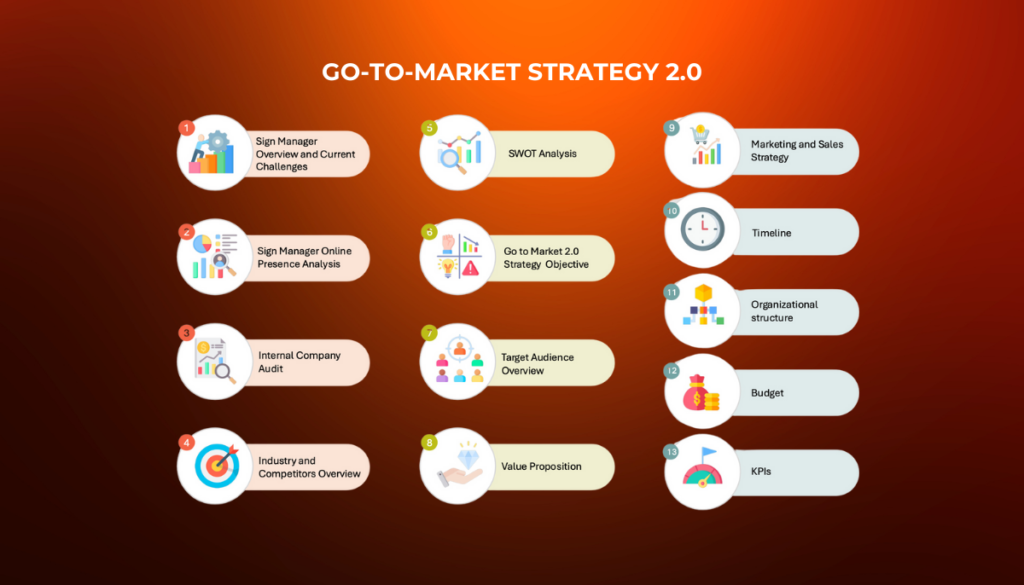
Go-to-Market Strategy 2.0
Developed a comprehensive Go-to-Market 2.0 strategy to reposition the company and drive business growth.
What was done:
Market and Industry Analysis
The last market analysis had been conducted in 2007, so the company needed to understand the current market landscape, competitors, marketing trends, and consumer insights.
Seven competitors were analyzed in detail, including their acquisition strategies, software tools, positioning, and messaging strategies.
Overall market opportunities were assessed to identify areas for growth.
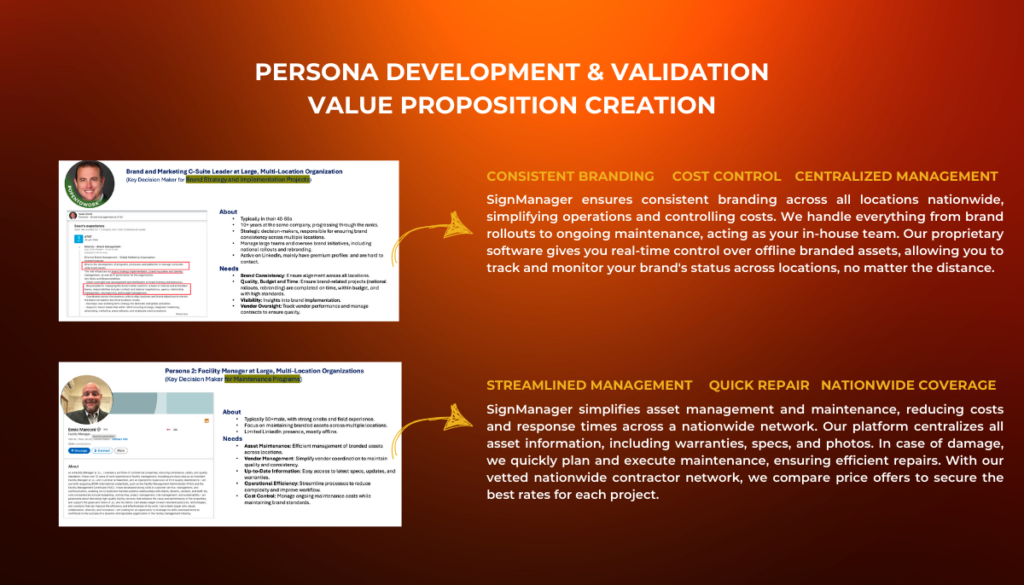
2. Consumer Insights Collection, Persona Development
Interviews were conducted with current and former employees of target audience companies to understand their internal decision-making processes and procurement workflows.
Using real research data, we developed buyer personas along with tailored value propositions and messaging for each.
3. Internal Audit
Both the Australian and U.S. offices were audited to evaluate internal culture, processes, organizational structure, team roles and responsibilities, and the motivation and evaluation systems.
Communication between the two offices was assessed.
The suitability of current team members for their roles was evaluated.
Key gaps and challenges were identified.
4. Leadership Alignment
Interviews and brainstorming sessions were conducted with the leadership team to align visions and goals for the U.S. market.
5. Go-to-Market 2.0 Strategy Development
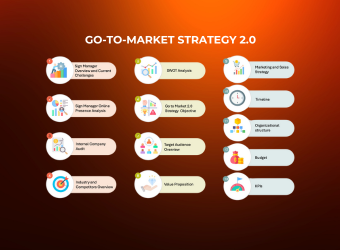
A comprehensive Go-to-Market 2.0 strategy was developed, outlining:
The company’s repositioning and new messaging
Unique selling propositions (USPs)
Service offerings
New team structure
Marketing and sales strategy
Implementation timeline
Key performance indicators (KPIs)
Budget allocation
Impact and next steps
The strategy was presented to top management and approved for execution. I continued supporting the company in a consulting role to ensure that the strategy was implemented effectively and that the company met its goals. As a first step, we began with a rebranding process in collaboration with a marketing agency that helped create a new brand identity, define core values, and effectively communicate the new culture to the internal team.
Positioning and Messaging Strategy for a Roofing CRM
SmartRoofing.ai, a SaaS company offering new AI-powered software for residential roofing contractors, sought to bring their new product to the market.While the industry was saturated with giant market players for housing and roofing vertical particularly, the product was offering unique features which needed to be effectively communicated and positioned. The goal was to define a clear market position, unique selling propositions, craft compelling messaging, and develop website content that resonated with roofing contractors.
Challenge: The roofing technology market was using mainly old school manual scheduling tools, workflows that are not automated and their target audience is not tech savvy. SmartRoofing.ai needed to effectively communicate the value proposition and work with potential customer objections.
At the same time for the established and more tech savvy roofing companies they were already using CRM systems such as Service Titan, JobNimbus, AccuLynx. While Smartroofing had an obvious competitive advantages, it was still challenging to beat the competition.
What was done:
Competitor Research
Conducted an in-depth competitive analysis to identify key differentiators and opportunities for positioning.
Mapped competitors’ messaging strategies to understand industry trends and customer expectations.
2. Positioning Strategy
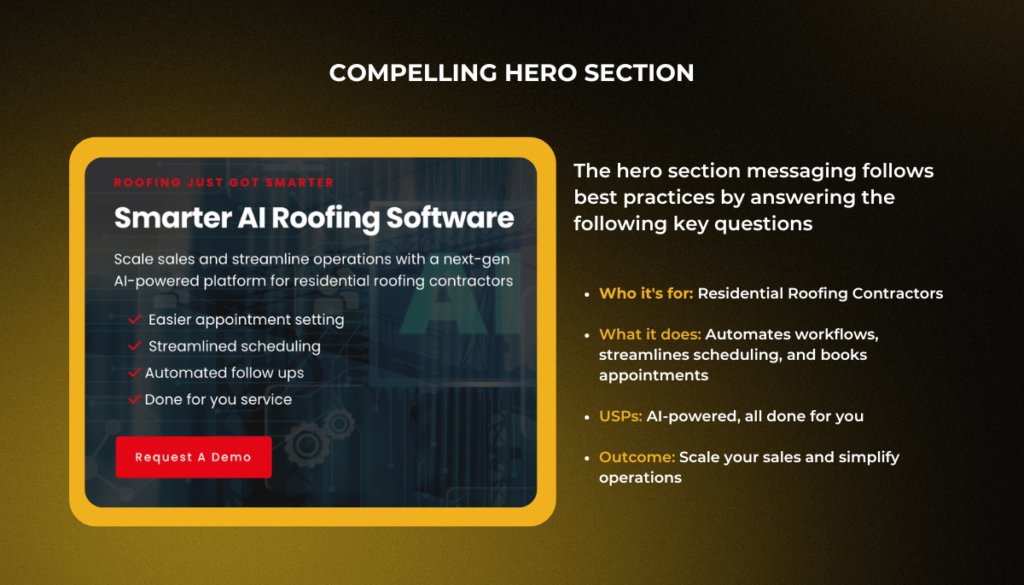
Developed a clear market positioning framework emphasizing the platform’s AI capabilities and direct business impact.
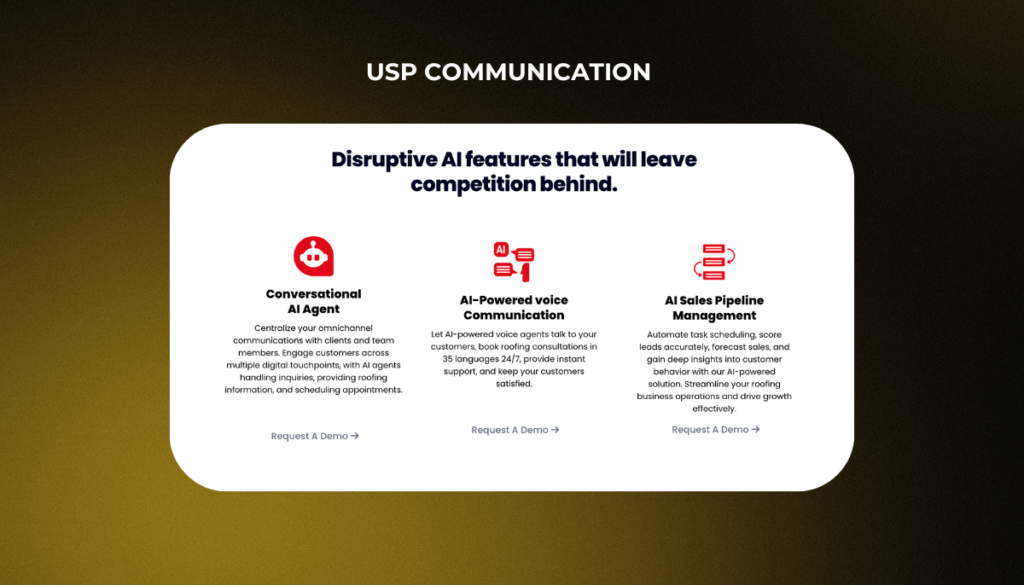
Defined unique selling propositions (USPs).
Created an internal positioning guide to ensure consistency across marketing, sales, and product teams.
3. Messaging Strategy
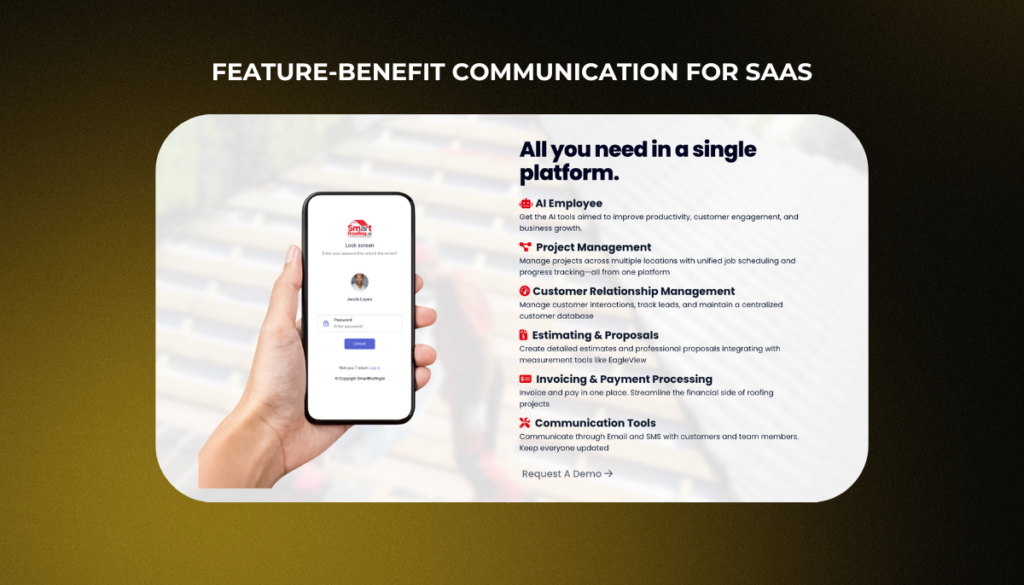
Built a feature-benefit-outcome framework, simplifying technical features into relatable business outcomes.
Identified key messaging pillars and unique selling propositions.
4. Website Content Creation
Created a simple and comprehensive website content guide to explain what the product does and how it can help solve roofers’ pain points.
Impact and next steps
In our time together, Smartroofing.ai launched its website with a cohesive, clear and benefit-driven messaging strategy. The new positioning resonated with their target audience, resulting in quick acquisition of the first 100 customers. Moving forward, the company plans to expand its content strategy based on the established framework, adding more pages to the website, creating sales decks and on-pagers and other sales and marketing materials to facilitate customer acquisition.
Establishing Product-Market Fit for a Fintech SaaS Startup
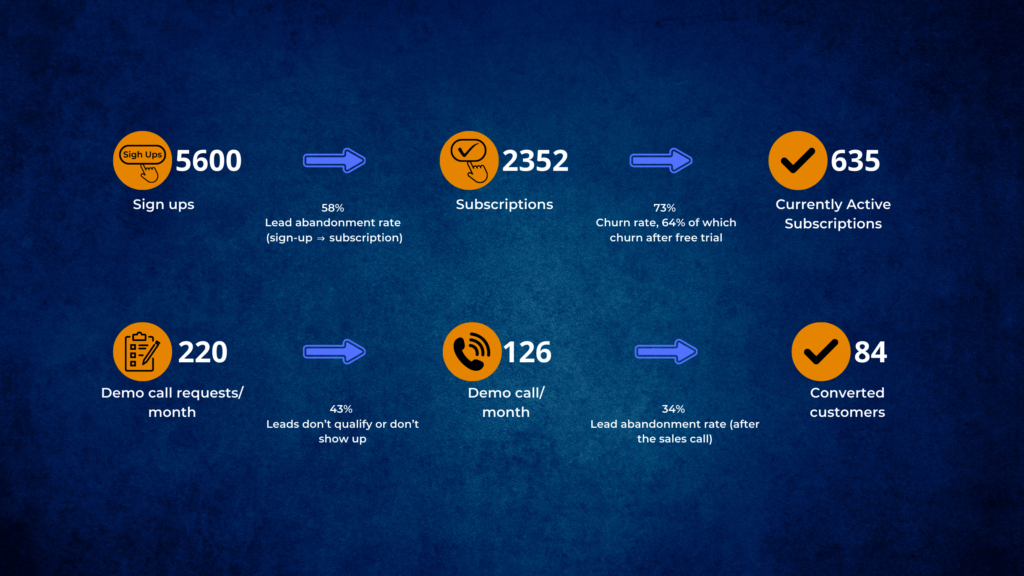
While the company was already launched in the market and had some organically generated customer base, it was struggling to find its product-market fit and prepare for growth. The company aimed to learn more about its customers, their pain points, their product requirements and use cases, refine the product based on that but also find a proven acquisition recipe for them that will constantly generate new leads.
Challenge: The company was launched in a very saturated market competing with giant market players with no specific positioning, making it harder to control customer acquisition costs. The two main focuses of the company were
Acquisition through
Paid ads, cold outreach, partnership programs and other channels
Organic channels and content strategy
Activation through
Product changes and A/B testing
Enhancing the onboarding experience with guided walkthroughs and refined product UX.
What was done:
Data Analysis & Dashboard Creation
Conducted in-depth analysis of company growth data and team structure.
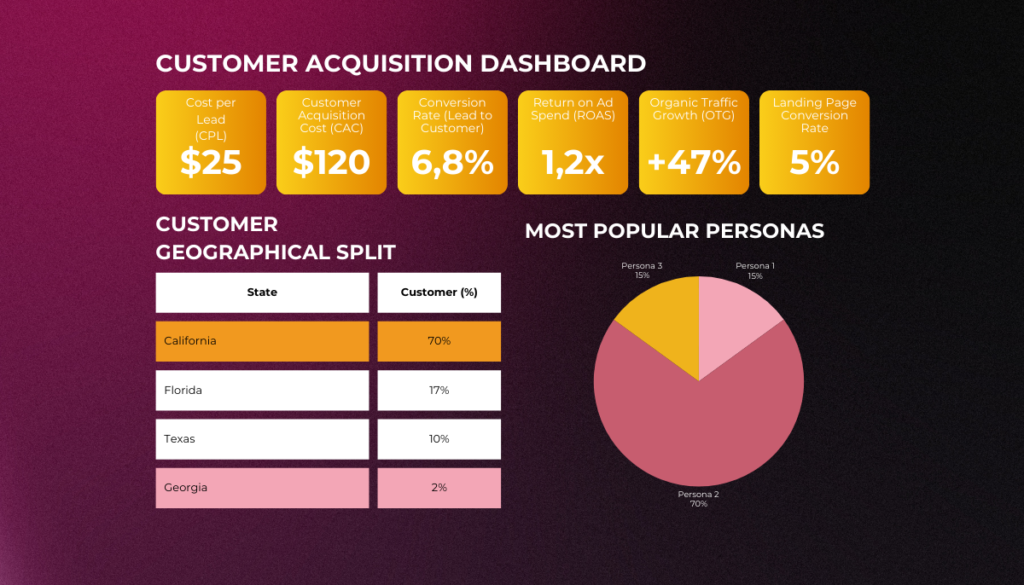
Led the creation of data dashboards from scratch, in collaboration with the data engineer, to consolidate data and automate key metrics for customer acquisition, activation, and retention, driving informed decision-making and KPIs.
2. Competitor, Market, and Customer Research
Conducted comprehensive research on both customer and competitor landscapes, analyzing trends, strengths, and market positioning.
Developed strategic direction based on insights gathered from the research, identifying opportunities for differentiation and growth.
Engaged with customers through interviews and surveys to gain deeper understanding, enhance market visibility, and refine product offerings.
3. Customer Acquisition Strategy
Identified the necessary resources to kickstart active customer acquisition, including hiring and interviewing talent, and setting up their respective channels for success.
Initiated acquisition through paid ads and cold outreach, with optimized resource allocation focused on high-intent conversions to improve lead quality.
Implemented structured conversion tracking to provide deeper insights and enable strategic adjustments.
Designed targeted abandonment recovery flows to capture leads at various stages of the consumer journey.
4. Customer Activation Strategy
Analyzed activation metrics and recommended UI/UX refinements to streamline onboarding and improve activation.
Hired and onboarded a new specialist to support clients in not only starting their subscriptions but also actively using the product.
Led multiple activation campaigns in collaboration with the onboarding team to drive engagement and usage.
5. Product-Market Fit Refinement
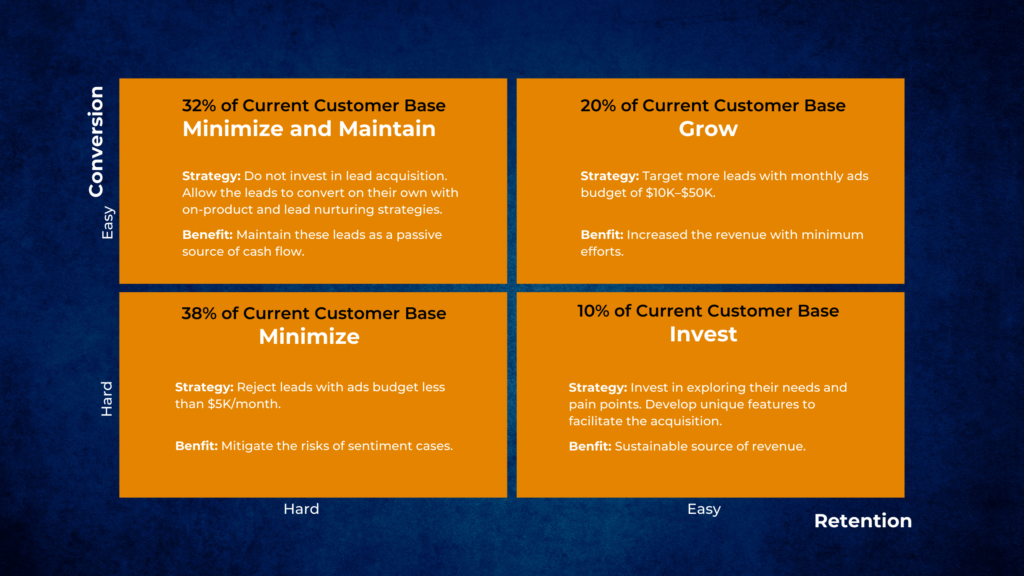
Based on ongoing customer acquisition and activation efforts, including customer interviews, surveys, and on-product surveys, existing personas were refined, and messaging was optimized to address their unique needs and pain points.
The onboarding process was enhanced by incorporating qualifying questions to better classify new leads, resulting in improved analytics interpretation by evaluating performance through the lens of these refined personas.
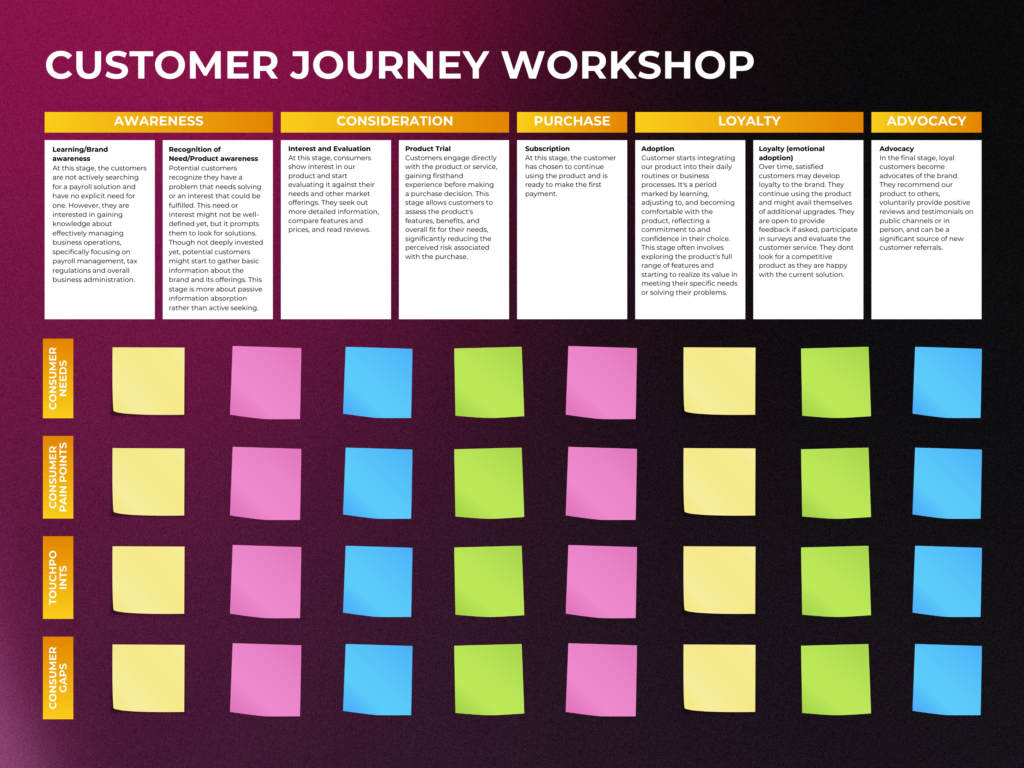
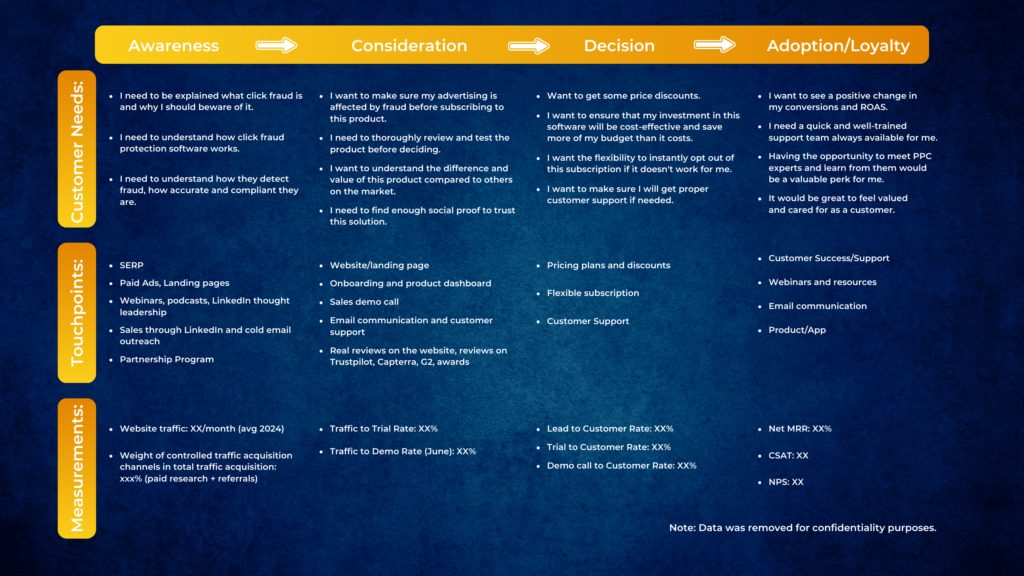
6. Consumer Journey Workshop
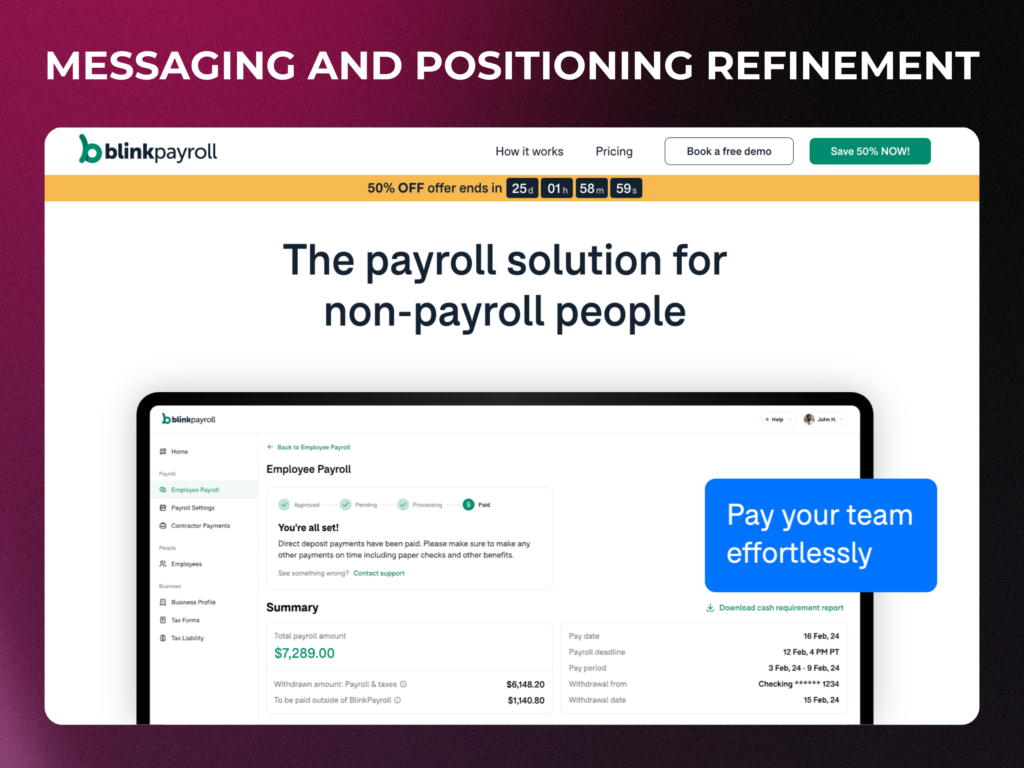
After extensive learning and data collection, including conversations with real customers and leads, analysis of paid and organic channel results, and understanding consumer needs and pain points through human onboarding and customer success, a consumer journey workshop was conducted.
This workshop helped align the knowledge of the real customer across the company and various functions, visualizing key touchpoints, identifying experience gaps and pain points, and generating new product and marketing initiatives to enhance the overall customer journey.
Impact and next steps
In just 3 months, customer acquisition and activation departments were created from scratch, with well-defined strategies and execution plans. Multiple campaigns were launched, tested, and optimized, providing valuable learnings that informed continuous improvements. The product-market fit, messaging, and buyer personas were refined through ongoing efforts, while analytics systems were built to support data-driven decision-making. The team was equipped with the necessary channels and toolboxes to ensure future growth and success.
Positioning a MarTech SaaS Company for Future Growth
The client company, already recognized as one of the top brands in its industry, faced a key challenge in advancing to its next growth stage. The company aimed to analyze past marketing efforts and develop a strategic roadmap to drive future growth.
Challenge: While the company was already a top-of-mind brand in its industry, they sought to accelerate growth and solidify their market position. To achieve this, they aimed to:
Analyze past marketing efforts
Review previous initiatives to identify successes and areas for improvement.
Develop a new growth strategy
Create a roadmap to improve visibility, brand positioning, and customer acquisition.
Establish a clear market position
Strengthen their reputation as a trusted, high-value solution in a competitive landscape.
What was done:
In-depth analysis of the company’s business and growth data
Examined historical performance in key areas such as customer acquisition, retention rates, and overall growth to identify strengths and weaknesses.
Analyzed past marketing campaigns, ads, content, and messaging to determine the effectiveness of each and uncover missed opportunities.
Reviewed the entire sales funnel, from lead generation to conversion, to pinpoint inefficiencies or missed opportunities in engaging and converting leads.
2. Competitor and market research
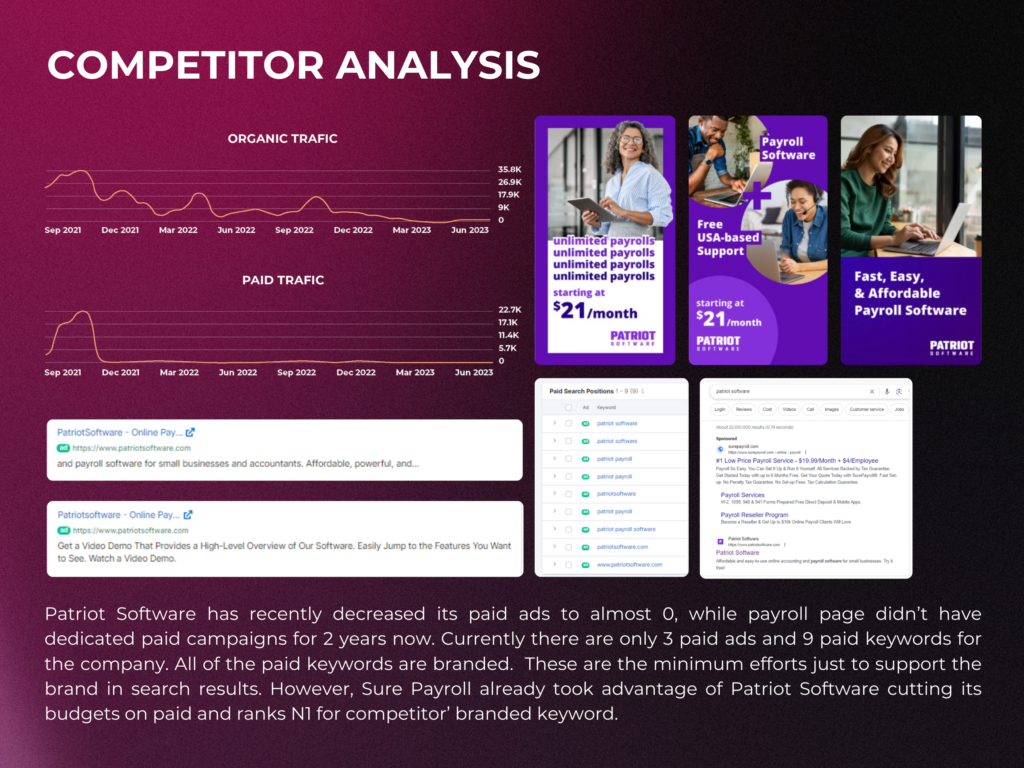
Reviewed competitor offerings and their positioning strategies to understand how they communicated their value to customers and where differentiation was possible.
Analyzed competitor ad campaigns, messaging, and content to assess their effectiveness in attracting and converting leads.
Examined the sales processes of competitors, focusing on lead generation, nurturing strategies, and overall conversion tactics.
Explored broader industry trends and customer pain points to ensure the company’s messaging aligned with what mattered most to potential customers.
3. Stakeholder collaboration and work with the team
With data insights and competitor analysis in place, a collaborative session was organized involving the company’s leadership, sales, and support teams. This session focused on:
Identifying the company’s unique selling propositions (USPs) to highlight key differentiators that made the product stand out.
Aligning on the company’s positioning and key messaging to ensure a unified narrative across all departments.
4. Strategic roadmap for growth
Drawing from the analysis and stakeholder input, a comprehensive strategic roadmap was developed to:
Define actionable steps to drive sustainable growth across key business areas.
Align efforts across teams to ensure a unified approach to achieving the company’s objectives.
5. Team hiring and training
Conducted interviews and created assessment tasks to evaluate and select the right candidates for key positions.
Successfully hired a Senior Marketing Manager to build a new team capable of implementing the new strategic roadmap.
Onboarded and trained the new hire to ensure they were well-equipped to contribute to the company’s growth objectives.
6. Execution
Led the team in executing the strategic roadmap, ensuring alignment with business objectives.
Drove growth across key metrics, including Monthly Recurring Revenue (MMR), Annual Recurring Revenue (ARR), number of subscribers, conversions, and cost per conversion.
Impact and next steps
In just three months of fractional collaboration, I completely reshaped the company’s marketing strategy through in-depth data analysis, competitor research, and a tailored go-to-market strategy. I restructured the team, hired a Senior Marketing Manager, and led the execution of the new plan. As a result, the company saw unprecedented increases in Monthly Recurring Revenue (MRR), Annual Recurring Revenue (ARR), and subscribers.
Next challenges to address include managing the rising customer acquisition costs and controlling churn rates, which have been partially organic but also within our control. Additionally, there’s a critical need to streamline the customer onboarding experience to better educate users and increase retention.